DOCS
How it works.
Walk. It eats. They pay you.
Everything here is how the app is coded today. When something is not live, it says so.
What it is
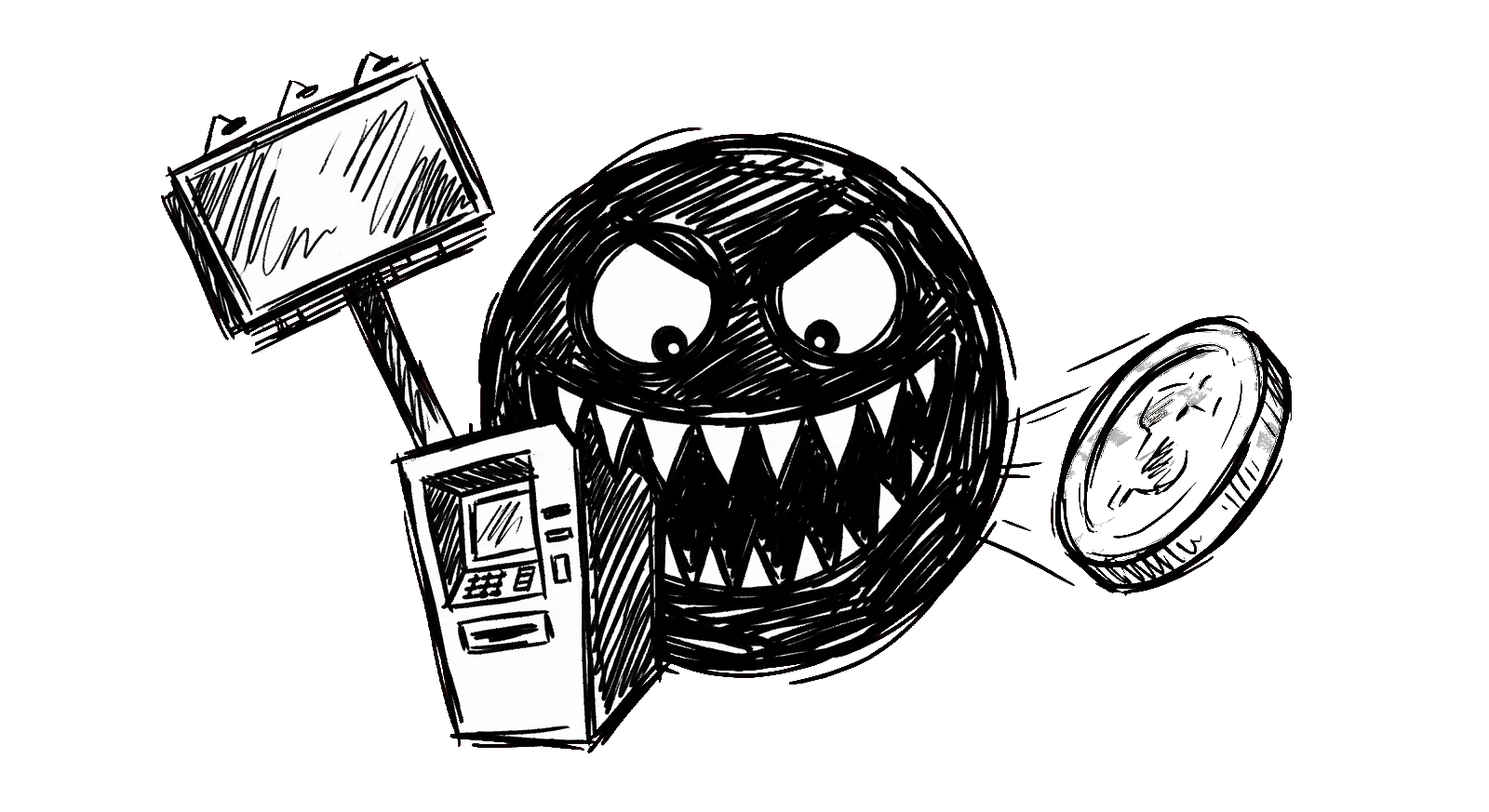
Everything you pass over falls in: the furniture of the city first (ATMs, billboards, gas pumps, EV chargers, antennas, parcel lockers, bus shelters), then buildings, then malls, stadiums and airports. Each thing has an owner. When the owner is a listed company, it pays you a fraction of its own tokenized stock, on Robinhood Chain. When it isn't, the index (SPY) pays.
The things come from OpenStreetMap, the world's open map: every object with a brand, an operator or a name is matched to a company and a ticker by a dictionary of a few hundred owners (banks, advertising groups, oil majors, charging networks, telecoms, hotels, retailers, mall owners, clubs, airports, utilities). Unknown owner: the index.
The rule
In demo mode it is pinned to the centre of the map and you drag the map. In GPS mode it follows your position.
Anything inside the hole's width, and small enough for its current tier, is swallowed the moment it passes under.
Each thing can be swallowed once. It disappears from your map and leaves a crater.
Each bite makes the hole wider. Each full day without a bite makes it 8% narrower, down to 8 m.
What it eats
Each bite widens the hole by the tier's growth times 60 ÷ (60 + current width): a 10 m hole gets almost the full bite, a 120 m hole a third of it. Swallowing a city takes days, not a drag.
Unbranded restaurants and cafés are not on the menu, only chains with a listed owner. A thing too big for your tier shows greyed: come back wider.
Growth
The hole starts at 10 m and can grow to 2 km. In a dense street a 25-minute walk eats about 40 things and covers about 1.7 km. From there:
Starving is checked when you open the app: every full day since the last bite takes 8% off, never below 8 m. Nothing you ate is lost, only the width.
The money
$CHOMP is not launched and the vault is empty. It starts empty: no presale, no seed, no allocation. The first payouts happen when the first fees have arrived. If the vault runs short, payouts wait in line; they are never invented. The contracts are written and tested (ChompVault, FeeSplitter); the day they are deployed, the proof page reads them live.
The scale is set so that a 25-minute walk in a dense district is worth about $30: some forty things, mostly crumbs and furniture, a few storefronts. Honest math: at $10,000 of daily $CHOMP volume the vault receives $135 a day, about four such walks. The daily cap keeps the line short; the volume decides how many walks get paid.
The chain
An Arbitrum-based network where Robinhood's tokenized stocks live as plain ERC-20 tokens. Payouts are made in those tokens, bought by the vault on Uniswap v3 from the official registry, 195 of them today.
Owners from our menu whose stock token exists there. Their things pay in their own token.
Most European and Asian companies, most banks, hotels and fast-food chains. Their things pay in SPY, the index token, and the app shows the real owner anyway. The day a company is listed on the chain, the registry is updated and its things switch.
vault/tokens.json, mirrored from docs.robinhood.com).Fair play
Live or not
Risks
Privacy
Today everything stays in your browser (localStorage): the hole, the trail, what you ate. No account, no server, no tracking. The map tiles come from OpenFreeMap and the things from public Overpass servers, which see the map window you ask for. GPS positions are used to move the hole and are not sent anywhere.
FAQ